Main Content
Amy Rowe, Rutgers Cooperative Extension
Pdf version: salem.njaes.rutgers.edu/wp-content/uploads/2026/06/Earth-Day-Every-Day-June-2026.pdf
Last month, members of the Earth Day Every Day team, attended the Association of Natural Resources Extension Professional’s (ANREP) Biannual Conference. This is one of our favorite conferences as we get to learn about natural resources programs and research conducted by our Extension colleagues from across the country.
The Association “provides a national peer-to-peer forum for members to network, innovate and collaborate while advancing the professional status and recognition of our unique role as educators in the field of natural resources.” Extension educators from across the country share and discuss emerging issues in the environmental and natural resources fields.
This year’s conference was held in Wilmington, North Carolina, right along the Cape Fear River. A summary of the conference is being provided as we thought our readers may be interested in what is happening in the natural resources arena across the country.
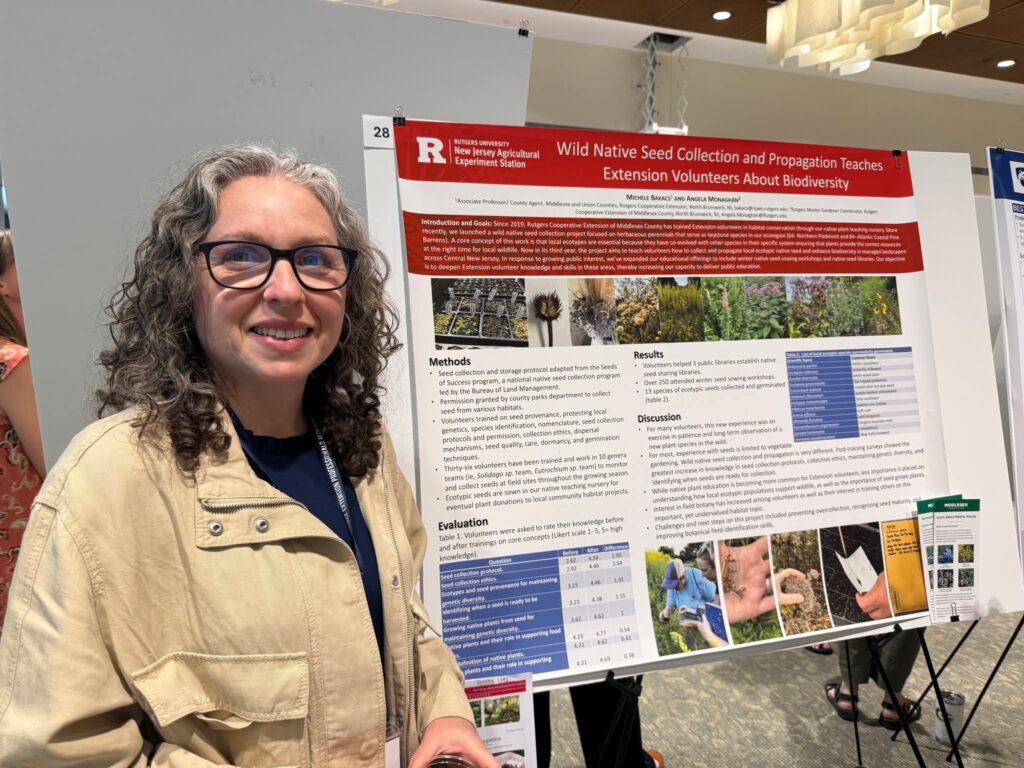
Michele Bakacs with her poster on teaching biodiversity to extension volunteers.
The conference theme was “Confluence of Knowledge: Charting the Future of Natural Resource Extension,” and the plenary session opened with dual presentations on the intertwined relationships between people and natural resources, through the lens of community and place. After that, there were presentation tracks on Forest and Urban Management, Environmental Education, Ecosystem Health, Water Resources and Community Development, as well as Program Design and Program Evaluation.
We heard about programs that were similar to the Rutgers Environmental Stewards class such as Master Naturalists, Forest Stewards, Pollinator Ambassadors, Woodland Stewards, and Green Landscape Stewards in Pennsylvania, Minnesota, and Georgia. All are adult education classes for the public focused on natural resources topics and emerging issues. We learned about improving delivery methods, how to make programming more engaging, and how to teach to a wide array of learning styles.
The Rutgers contingency gave several presentations and posters with topics including enhancing forest stewardship, teaching biodiversity to extension volunteers, propagating native plants, and reducing food waste on college campuses. Conference presentations are important for extension educators to get feedback on their programs, to hear about ways to improve their offerings, and to offer suggestions to other professionals that want to run similar classes.
The best parts of any conference are the field experiences, which are tours showing the uniqueness of the conference venue’s local area and natural resources industries. The field trip I attended was called, “Pocosins to Pines: North Carolina’s Unique Ecosystems.” A pocosin is a freshwater bog with acidic and nutrient-deficient soils. This trip focused on the unique ecosystem found in the southeastern corner of North Carolina. We saw the endangered red cockaded woodpecker, which prefers to nest in longleaf pines, as well as carnivorous plants such as sundews, Venus fly traps, and multiple species of pitcher plants. North Carolina’s pine forests are different from our New Jersey pine barrens in several ways. The dominant pine tree in NC’s pinelands is the longleaf pine, while that of NJ is the pitch pine. In North Carolina, the growing season is much longer and winters often do not have prolonged freezing events, while New Jersey winters can be below freezing for weeks or months, leading to species differences between the two areas. The two ecosystems do have some similarities with both forests being fire-dependent. Both natural and human prescribed burns keep the forests healthy by encouraging seed germination, controlling risky fire fuel accumulation, and managing invasive species that are not adapted to fire.

From left to right: Venus fly traps, longleaf pine trees, and pitcher plants.
My Earth Day Every Day colleague, Michele, went on the North Carolina Oyster Trail field trip, which showcased NC’s oyster industry from seeding to shell recycling. One of the stops was the Shellfish Research Hatchery at the University of North Carolina’s Wilmington campus. This facility focuses on the early life stages of marine bivalves (oysters, scallops, shells, and clams) and researches selective breeding, diversification, and best practices to improve crop yields. The tour group also visited the NC Coastal Federation Office, which works to protect and restore the important North Carolina coast. Their efforts focus on rehabilitating salt marshes, improving water quality, removing marine debris, and restoring oyster populations.
Finally, the conference offered a way for natural resource Extension professionals from across the country to come together and collaborate on important emerging issues. We broke into subject matter groups and discussed ways to educate the public and to work together on resources, grants, and webinars. The groups that met at this conference were wildland fire, energy, native plants, and water. Bringing minds together will hopefully lead to solutions to some of our most pressing environmental challenges.
Overall, this year’s Association of Natural Resource Extension Professionals conference was an informative experience, and it was great to connect with so many of our Extension colleagues from around the country in a beautiful location. We look forward to the next conference that will be held in Duluth, Minnesota, in 2028.
For more information on the Association of Natural Resource Extension Professionals, please visit their website at anrep.org/.
Logo for the Association of Natural Resource Extension Professionals.